
Reading the coastal property market this October
By Penrose Bay EditorialPublished October 3, 20266 min read
October is a good month to read a market. The beaches have emptied a little, the terraces are still open, and the people who stayed on after the summer have settled back into ordinary routines. It is also when the first full picture of the summer's sales starts to appear in the official figures.
We should be plain about how this note works. Penrose Bay is not an agency, we have no sales of our own to report, and we do not want to hand you a number we cannot trace to a named source. So rather than a list of headline percentages, this is a guide to what the Costa del Sol and the Costa Blanca have been doing in broad terms, and to where you can read the current figures yourself.
The direction, in words, is this. Across the last several years, prices along both coasts have mostly moved upwards, and the more sought-after parts of Málaga province have moved furthest. The Costa Blanca has generally been the gentler of the two, though its best-known towns have not stood still either. Whether that continues is not something any honest source can promise.
Two coasts, two sets of questions
The Costa del Sol is a long, busy stretch with very different personalities along it. Marbella, Estepona and Benahavís sit in one conversation about price; Fuengirola, Torremolinos and Málaga city sit in another; the eastern towns around Nerja and the Axarquía in a third. A single provincial average hides all of that, and it is worth remembering whenever you see one quoted.
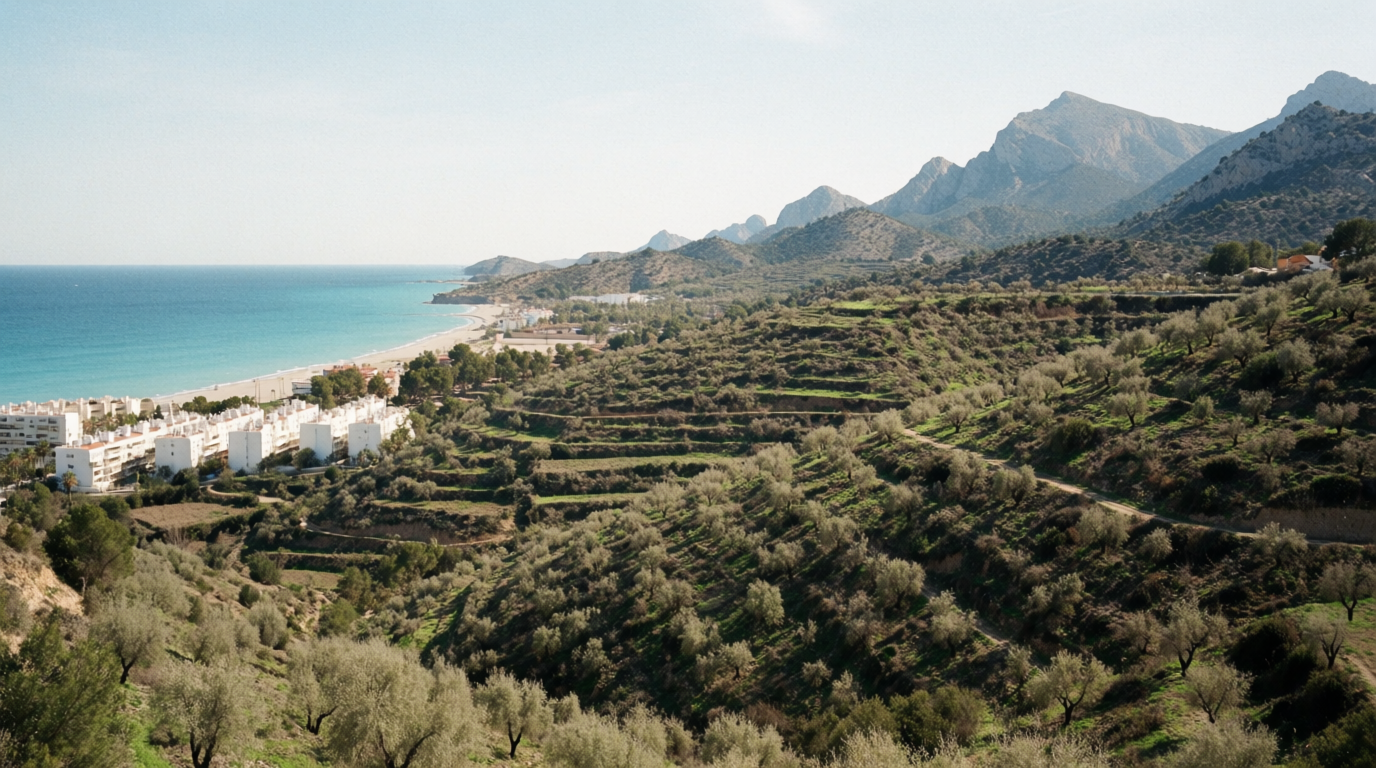
The Costa Blanca works the same way. Jávea, Altea and Calpe in the north tend to be discussed separately from Torrevieja, Orihuela Costa and Guardamar in the south. The north has more hills and more established towns, and the south has flatter ground, more apartment and townhouse stock, and a long habit of year-round residents from northern Europe.
The practical point is that you should read the market for your own town and your own type of home, not for the coast as a whole. A new apartment near the beach and a village house inland are, in effect, different markets sharing a postcode region.

Who is buying, and where to check
Demand by nationality is one of the most quoted and most misquoted parts of the story. The reliable source is the Registradores de España, whose statistics on property transactions include a breakdown of foreign buyers by nationality and by province. The Colegio de Registradores publishes these on a regular cycle, and they describe deeds that have actually been registered, not enquiries or intentions.
The Consejo General del Notariado is the other source worth knowing. Notaries see the deed at signing, so their data tends to arrive earlier than the registry's, and it includes average prices per square metre and the split between new and resale homes. Between them, you get a fairly clear view of both volumes and prices.
The Instituto Nacional de Estadística (INE) publishes its own housing price index and transaction counts, built largely from registry and notarial information, so it lags a little. That is useful to know. If a headline claims that the market changed in a particular month, it is usually reporting something that was signed some time before.
Asking prices tell you what sellers hope for. Notarial and registry figures tell you what actually changed hands.
That distinction matters more than any single number. Listings on the portals are an indication of mood, and the deed is the record of fact. When the two drift apart, as they sometimes do, the gap itself is informative.
Supply, and why it shapes the search

The other half of the picture is how much is available. On much of the Costa del Sol, buyers have for some time talked about a shortage of well-located resale homes, and new developments have been slower to arrive than demand might suggest, partly because of land, licensing and build times. Along the Costa Blanca, new-build activity has been more visible in the south and in the northern towns with remaining plots.
What that means for you is mostly about patience and about what you are willing to compromise on. A home that fits your list on location, orientation, community fees and walking distance to a bakery does not appear every week in the towns people most want to live in. Knowing that in advance makes a search calmer.
It also means that off-plan purchases deserve a slower, more careful read than a finished home. You can see a resale, walk its street at eight in the morning and ask the neighbours about the lift. An apartment that does not yet exist asks you to trust a programme and a bank guarantee, and that is a place where a good independent lawyer earns their fee.
What has changed around the edges
Price is rarely the only thing that moves. Rules on residency, taxation and short-term letting have all been under discussion in Spain in recent years, and several of them differ by region, since the Junta de Andalucía and the Generalitat Valenciana set their own transfer tax and tourist-rental rules within the national framework. We have written about some of this separately, and we would suggest you check the current position with the Agencia Tributaria and the relevant regional tax office before assuming that anything you read, including here, still applies.
Infrastructure matters too, though it is quieter. Airport connections at Málaga and Alicante-Elche, road works on the A-7 and AP-7, and regional rail plans shape which towns feel close to a flight and which feel a long way off. It is worth driving or taking the train between your airport and the town on a normal weekday rather than relying on a map estimate.
What this means if you are starting now
Start with the official sources, not the loudest headline. Look at the Registradores and Notariado pages for the province you care about, and at INE for the long view, and write down for yourself what you actually find.
Then narrow the question. Choose two or three towns, one type of home, and a realistic budget that includes the purchase costs on top of the price, which vary by region and by whether a home is new or resale. Visit outside August, ideally on a weekday, and eat lunch where the locals do.
Finally, build your team before you fall in love with a particular house: an independent lawyer who works for you alone, a gestor if you need one, and a surveyor for older properties. A search that begins with the people and the process tends to end better than one that begins with a photograph.
If you would like to talk through which stretch of coast suits the life you have in mind, or be introduced to vetted local professionals when you are ready, get in touch. We are happy to help you ask better questions, at whatever pace suits you.
The introduction
The local expert who knows this coast
We are not the estate agency. We are the introduction. When a piece like this turns into a plan, we connect you with a vetted local expert who knows the town and speaks your language.
Find your local expert