

Asking, appraised, registered: which coastal price to trust
By Penrose Bay EditorialPublished October 7, 20265 min read
If you have spent an evening reading about prices on the Spanish coast, you will have noticed that the numbers refuse to agree. One page says a square metre in a town costs one thing, another says something quite different, and a third says sales are falling while prices rise. None of them is necessarily wrong. They are simply measuring different things.
So this October, rather than add one more headline figure to the pile, we would like to show you how to read the three kinds that matter. Once you can tell an asking price from an appraised value from a registered sale, the coast becomes much easier to read, and a lot less noisy.
We will use the Costa del Sol for most of our examples, because that is where the freshest published figures are. For the Costa Blanca we will be honest about what we can and cannot quote.
Asking prices: what sellers hope for
Most of the figures you meet online are asking prices, taken from listings. They are quick to update and they move first, which makes them useful for sensing direction. They are also what owners would like to receive, not what changed hands.
As one example, the Olive Press reported in March 2026, citing Idealista data, that the average asking price in Marbella had reached a record of about €5,607 per square metre. In the same piece, asking prices in Manilva, long one of the more affordable western towns, were reported to be up 17.2% on the year, at around €2,934 per square metre.
Those numbers tell you something real about ambition and about where attention is moving. They do not tell you what a buyer who negotiated sensibly eventually paid. Treat them as a weather vane, not a receipt.
Appraised values: what a valuer says it is worth
The second kind comes from valuations, the appraisals that banks commission when a mortgage is involved. Spain's Ministry of Housing and Urban Agenda publishes these by province. According to its figures for early 2026, as summarised by Target Property Spain, Málaga province averaged about €2,988 per square metre, up 14.2% on the year.
Tinsa, a valuation company, publishes its own index. Its IMIE figures, reported by Just Real Estate, put the rise in Málaga province prices at 13.1% in the first quarter of 2026 against the same quarter of 2025.
Two different sources, two slightly different numbers, and the same direction. That is the pattern worth noticing. Appraised values smooth out the extremes of the glossiest listings, and they cover the whole province, so a figure for Málaga includes the city, the Axarquía and the inland towns, not just Marbella.
Registered sales: what actually happened
The third kind is the quietest and the most honest: deeds registered at the property registry. The Registradores de España publish these, and the Instituto Nacional de Estadística (INE) publishes its own monthly transaction series.
Here the Costa del Sol picture is more nuanced. According to Registradores figures reported by Just Real Estate, Marbella, Estepona and Benahavís together registered 1,566 residential sales in the first quarter of 2026. That is 30.2% fewer than the same quarter of 2025, and 36.0% fewer than the quarter before.
It is worth reading that carefully. It covers three municipalities, one quarter, and a registry count that can lag the signing of a deed. It is a prompt to ask questions, not a verdict on the whole coast.

Prices rising while fewer sales are registered can mean a market that is selective, not one that is running away.
That sentence is our reading, not a forecast. It simply reflects that when both figures move together in this way, the likely explanation is that fewer, more determined transactions are setting the price.
And the Costa Blanca?
We would rather leave a gap than fill it with a number we cannot stand behind. We do not have a freshly sourced Alicante province price or sales figure to give you here, so we will not offer one.
What we can say is that you can run the same three-part test yourself. Look at asking prices in the town you like, then the Ministry of Housing's appraisal data for Alicante province, then the registered transactions from Registradores and INE. Where the three tell the same story, you can trust it. Where they diverge, ask why.
The divergences are often the most useful part. A town with high asking prices and little in the registry may simply be a place where sellers are waiting. A town with modest listings and brisk registrations may be where people are quietly buying.
What this means for your search
A few practical habits will serve you better than any single statistic:
- Compare like with like. A provincial average, a town average and a street are three different questions.
- Check the date and the source before you trust a number, and notice whether it is asking, appraised or registered.
- Look at the same town in more than one source before you decide it is cheap or dear.
- Walk the streets in the quiet weeks. October is a good month for it, with the beaches calmer and the bars full of residents.
- Ask a vetted local expert what similar homes in that exact building or urbanisation have actually sold for.
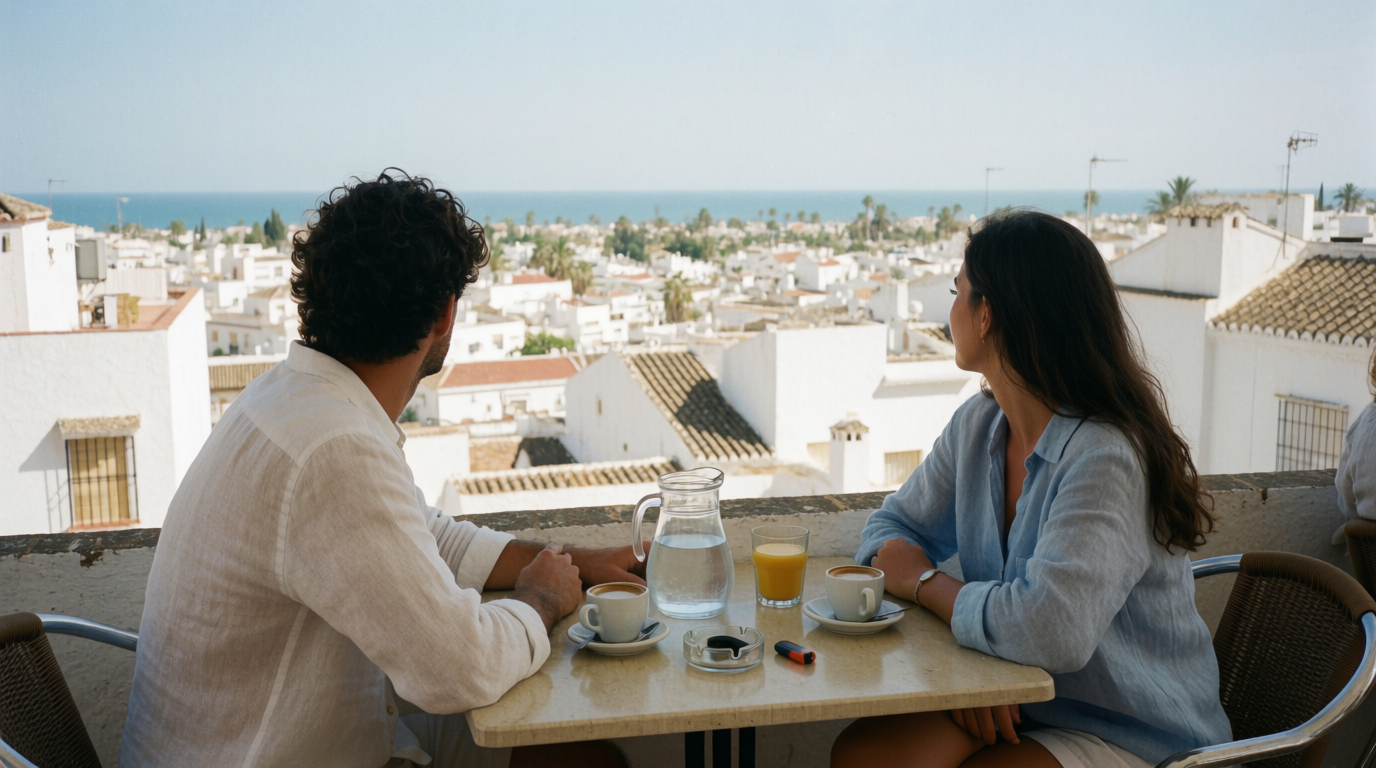
None of this needs to be rushed. The figures will still be there next month, and you will read them better after a week of coffee on a terrace in the place itself.
If you would like a second pair of eyes
We are not an agency and we do not sell property. If you would like help making sense of the numbers for a particular town, or an introduction to a vetted local lawyer, surveyor or adviser on either coast, get in touch. We would be glad to point you in the right direction, whenever you are ready.

The introduction
The local expert who knows this coast
We are not the estate agency. We are the introduction. When a piece like this turns into a plan, we connect you with a vetted local expert who knows the town and speaks your language.
Find your local expert